
Almost every company has people who spend most of the day at a screen: admin, customer care, purchasing, reception. Italian law sets clear rules for them, but the same questions keep coming up. Is a medical check-up required? Does it have to be done by an eye specialist? Do hours at the computer from home count?
Here is what Legislative Decree 81/2008 (Italy’s Consolidated Act on Health and Safety at Work) actually says, including the 2026 updates.
Who counts as a display screen worker: the 20-hour rule
Under Italian law, a display screen worker (videoterminalista) is an employee who uses display screen equipment “systematically or habitually, for twenty hours a week”, after deducting breaks (Art. 173).
Breaks can be pauses or a change of activity, and collective agreements, including company-level ones, decide how they work. If there is no agreement, workers are entitled to a 15-minute break after every 120 minutes of continuous screen work (Art. 175). The break counts as working time and can’t be saved up and taken at the start or end of the day.
2026 clarification: time counts, not the type of screen
In Interpello no. 3/2026 (session of 24 September 2026), the Ministry of Labour’s committee for official queries (Commissione per gli interpelli) restated a principle already written into the law. Where use is systematic or habitual for at least 20 hours a week, the display screen rules apply “regardless of the type of activity or the nature of the images displayed”.
The query came from underground railway station staff, who work in control workstations with monitors. In practice, what matters is the time actually spent at the screen, not the role or the kind of work.
An interpello doesn’t change the law: it is the Ministry’s guidance on how to apply it. The committee also answers general questions only, not individual cases, so the 20 hours need to be checked against how work is really organised in your company.
Medical check-up or eye test?
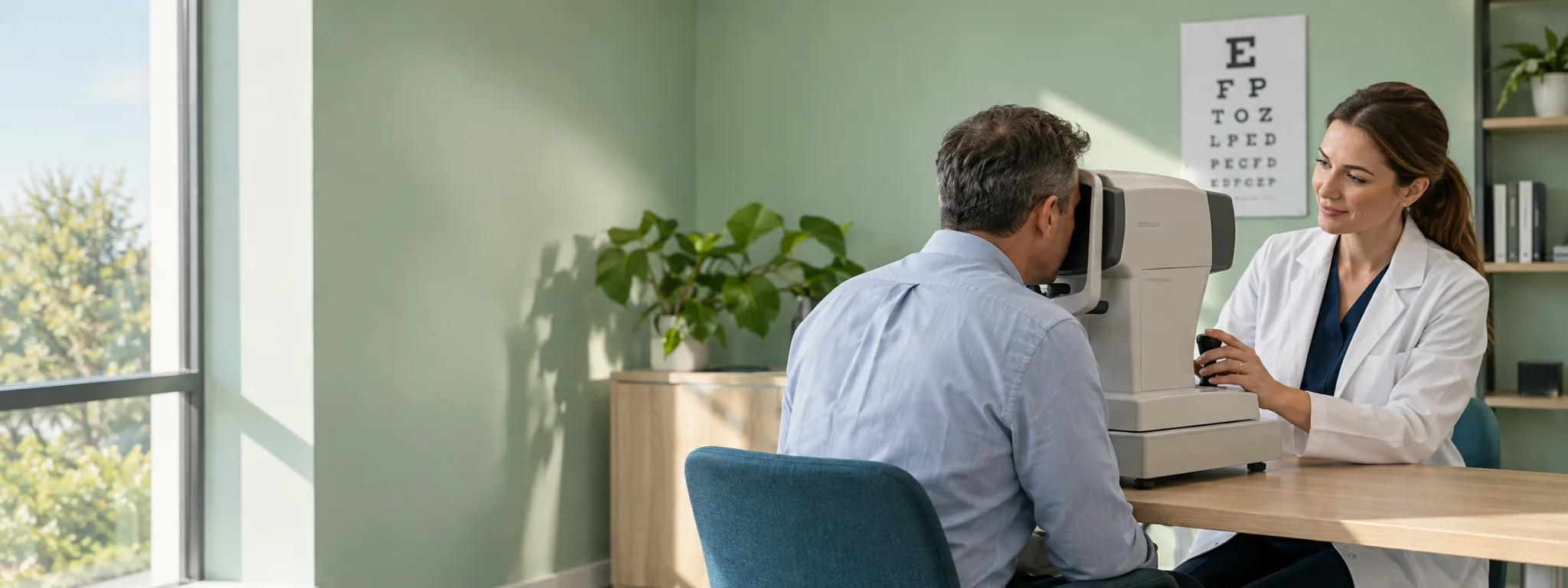
This is the most common mix-up. The legal requirement is a check-up by the occupational physician (medico competente), not an eye test. The physician assesses the worker with particular attention to two areas (Art. 176):
- eyesight and eye health;
- the musculoskeletal system (back, neck, shoulders, wrists).
An ophthalmologist only gets involved if the occupational physician decides a closer look is needed, for example when a problem comes up during the check-up. The check-ups include any tests the physician considers necessary, and the employer arranges and pays for them (Art. 41, paragraph 4).
What about glasses? If the check-up shows that special corrective glasses are needed for screen work, and ordinary glasses won’t do, the employer must provide them at its own expense (Art. 176, paragraph 6). Everyday prescription glasses, which correct problems unrelated to screen work, are not covered.
The Court of Justice of the EU (case C-392/21) points the same way: what matters is that the glasses correct a vision problem linked to screen work, and the employer can either supply them directly or reimburse the cost.
How often is the check-up done?
First comes the pre-placement check-up, carried out before the worker starts the job, including before hiring. After that, periodic check-ups follow this schedule (Art. 176, paragraph 3):
| Who | How often |
|---|---|
| Workers aged 50 or over | Every 2 years |
| Workers found fit subject to conditions or restrictions | Every 2 years |
| Everyone else | Every 5 years |
| Special cases | As often as the occupational physician decides |
Three other situations call for a check-up:
- Change of role: if a worker moves to a job that involves using a display screen, a new check-up is needed (Art. 41, paragraph 2, letter d).
- Temporary unfitness: the occupational physician decides when to repeat the check-up.
- At the worker’s request: workers can ask for a check-up, and it goes ahead if the physician considers it linked to work-related risks or to health conditions that work could make worse (Art. 176, paragraph 5, and Art. 41).
Smart working: do hours at the computer from home count?
With hybrid working, this is the question that most often puts HR on the spot. Here is what the law says:
- Teleworking (telelavoro): for people who work remotely on a continuous basis, the display screen rules apply “regardless of where the work is carried out” (Art. 3, paragraph 10, Legislative Decree 81/2008).
- Smart working (lavoro agile), new in 2026: since 7 April 2026, when smart working takes place somewhere the employer doesn’t have at its disposal, usually the worker’s home, the safety obligations that fit this arrangement, especially those on display screens, are met through a written notice on general and specific risks. It must be given to the worker and to the Workers’ Safety Representative (RLS) at least once a year (Art. 3, paragraph 7-bis, Legislative Decree 81/2008, introduced by Law 34/2026). The notice was already required by Art. 22 of Law 81/2017, but failing to provide it is now subject to criminal penalties.
No provision says how to count the hours of people who split their time between office and home, and there is no ministerial guidance yet on how the new notice fits with the medical check-up. Several experts believe the notice doesn’t replace health surveillance once the 20 hours are exceeded, but that remains an interpretation. The definition of a display screen worker rests on screen use, not on location, so the most prudent reading is to count all the hours.
Here is an example. A services company with 40 employees has an administrative employee who works 3 days in the office and 2 from home, always at the computer, for about 5 hours of actual work a day, excluding breaks. In the office she reaches 15 hours a week, below the threshold. Add the 10 hours from home and she reaches 25, above the 20-hour line. Treating her as a display screen worker and including her in health surveillance is a prudent choice that protects both her and the company.
This classification belongs in the risk assessment, made together with the occupational physician.
What the company risks
Failing to provide health surveillance for display screen workers, meaning the check-ups and frequencies set by Art. 176, is a criminal offence for the employer and managers. The penalty is short-term imprisonment (arresto) of three to six months, or a fine (Art. 178).
How Skema HSE can help
A fitness-for-work assessment is only really useful if whoever writes it understands how work is done in that setting. That is why Skema HSE is organised by sector: we pair each company with an occupational physician who knows its world, with its typical jobs, pace and risks. That includes offices, where screen hours, workstations and hybrid working all matter.
A physician who knows the sector builds a health surveillance plan around the real risks, with no unnecessary tests and no gaps, and writes conditions that can actually be applied. We carry out check-ups on your premises with our Mobile Unit or at partner clinics, across Lombardy and the Milan area, with a single point of contact for your company.
If you would rather hand over deadlines, appointments and coordination with the physician too, there is Skema Health Desk, our outsourced administrative service for occupational health.
Learn more: Occupational health in offices and indoor work environments
Discover all the sectors we work in
Read our LinkedIn post (in Italian): “The right physician is the one who knows your work”
Frequently asked questions
Is the display screen worker check-up done by an ophthalmologist?
No. It is done by the occupational physician, who can request an eye examination if needed.
How often is the check-up repeated?
Every 5 years, or every 2 years from age 50 and for workers fit subject to conditions or restrictions, unless the occupational physician sets a different frequency.
Do smart working hours count towards the 20 hours?
For continuous teleworking, yes (Art. 3, paragraph 10). For smart working, the law doesn’t say how to count them and, since 7 April 2026, requires an annual written notice (Art. 3, paragraph 7-bis). The most prudent approach is to count them and assess each case with the occupational physician.
Who pays for the check-up and the glasses?
The employer pays for the check-up and any tests the occupational physician requires. The same goes for special corrective glasses, when they are needed.
Legal references
Legislative Decree 81/2008, Arts. 3 (paragraphs 7-bis and 10), 41, 173, 175, 176, 178 · Law no. 34 of 11 March 2026, Art. 11 · Law no. 81 of 22 May 2017, Art. 22 · Interpello no. 3/2026 (Commissione per gli interpelli, session of 24 September 2026) · Court of Justice of the EU, judgment C-392/21 of 22 December 2022.
Updated 22 November 2026.